1. Organizations face the challenge of reinventing themselves – business models, modes of work, patterns of thinking & response, and resetting the expectation structures of various stakeholders.
How to reinvent themselves rapidly, smoothly, and with the least pain & disruption.
2. The response to this challenge is the ‘Collective Mind Approach’.
What does the ‘Collective Mind Approach’ mean? It means reinventing something deeper than business models, modes of work, patterns of thinking, or expectation structures.
The architecture of collective self-belief, collective maps of becoming, the collective ability to reinvent itself, the collective mode of engaging with the challenges faced by the organization.
(i) The collective self-belief is needed if the organization must find in itself the strength & the will to change or reinvent itself.
(ii) Collective maps of becoming are needed to grow & evolve. The collective must recognize where it is and also recognize where it must go.
(iii) Collective ability to reinvent itself means that the organization must have the adaptability, the shared capacity to give people both the space and the impetus to do things differently. This means a reinvention of the collective discourse, the protocols that shape engagement, the changes in leadership frames, and the shifts in collective work modes.
(iv) Collective mode of engaging with challenges means mutual trust, the capacity to come together to address an issue, the willingness to listen & accept multiple points of view, the bridge between knowing what to do & collectively doing it, the shared solutioning capacities, and the collective belief that the collective has the capacity to solve its own problems without dependence on outsiders.
3. How is this ‘collective mind’ of an organization to be awakened so that it is able to reinvent itself effectively?
A six-step roadmap:
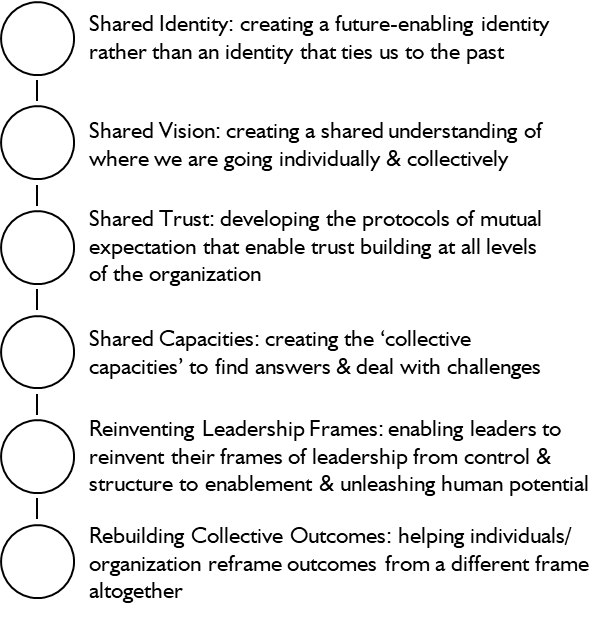
This six-step roadmap is critical for organizations to position themselves for change and growth.
- Identities stuck in the past can severely block all acceptance of new thoughts & ideas, and create deep personal collective resistance to growth.
- The absence of a shared vision can mean that individuals are uncertain about their personal futures and are at the same time unable to sensemake the organization’s direction or leadership choices.
- The absence of mutual trust can mean (i) loss of effective communication (ii) unwillingness to act speedily & together (iii) constant second-guessing (iv) poor commitment levels and unwillingness to take risks of any kind.
- The absence of shared capacities means that even if individuals in the organization want to act effectively, they don’t know ‘how’. This slows them down, and valuable time & energy is lost in reinventing the wheel, making unavoidable mistakes, loss of enthusiasm due to constant “operating” difficulties.
- Rigid leadership frames means that leaders focus on techniques of managing rather than re-examining or clearly communicating the basic frames driving their engagement, communications & behaviors.
Leadership frames shape organizational agendas and therefore need to be “custom built” for the specific organizational context. - All of the above need to find fruition in an evolved set of organization outcomes. These organization outcomes need to be specified. It is these outcomes that will help the organization reinvent its model of business.